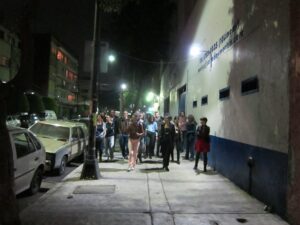
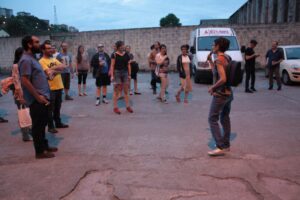
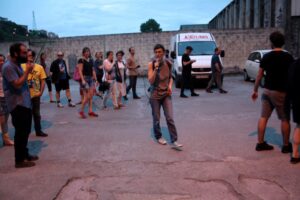
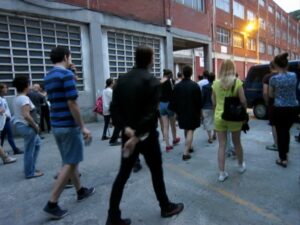
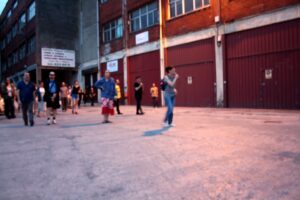
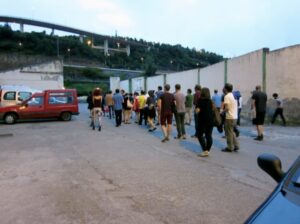
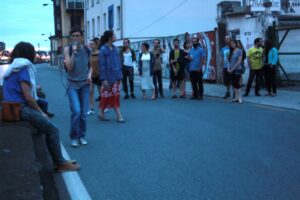
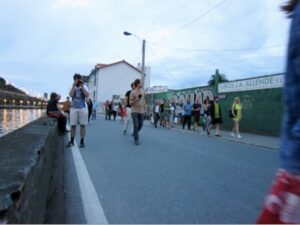
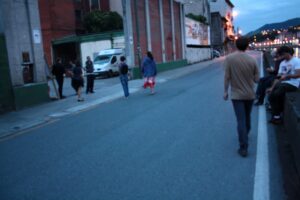
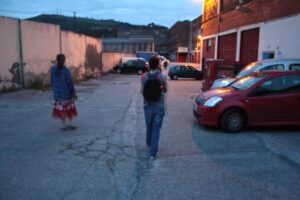
In 2013, Amaia Urra revisits in Una vuelta-ta the technique of naming what she sees, which she had previously used in Pantalón Vaquero and Muleta Gris (2012). In Una vuelta-ta, the audience accompanies Amaia on a stroll through the city, during which she improvises a soft hum to name whatever catches her attention. The pace of this piece is relaxed, and the slow walk matches the rhythm of the melody. Amaia’s voice guides the audience’s gaze in a calm, almost dreamy tone, creating a sense of shared intimacy. To achieve this, rather than projecting her voice, Amaia uses a portable PA system that allows her to amplify a voice somewhere between a whisper and a sing, with her mouth very close to the microphone —a precise vocal technique she often uses in much of her work.
The intonation that Amaia employs in many of her pieces is neutral ‘but not dry’, (almost) devoid of emotion, which creates an effect of intimate detachment, giving rise to a space of possibility between two qualities that are, in principle, opposites. In For More Than One Voice: Toward a Philosophy of Vocal Expression (2003), Adriana Cavarero proposes an ontology of the voice based on the uniqueness of each body and on human relationships. For Adriana, this ontology could serve as an alternative to the traditional subordination of the voice (phoné) to abstract meaning (logos) in the Western philosophical tradition. Cavarero theorises how intimate vocalisation (murmuring, whispering or singing between lovers or between mother and child) renounces the public function of political or informative discourse to withdraw into the pure relationship between bodies. The voice thus acquires a tactile, haptic quality, to which Amaia also refers to in her text Frondoso Matorral (‘Luxuriant Bushes’).
See: Early works, C/Aldamar (2012), Pantalón vaquero (2012), Muleta gris (2012), Berio pasalekua (2014), Pulkiki pulfiki (2023)