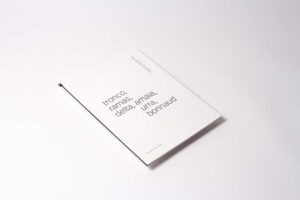
Tronco, ramas, delta is an artist book self-published by Amaia Urra and created in close collaboration with the designer Maite Zabaleta. It brings together the graphic versions of various pieces from the series Deriva de sinónimos. These graphic versions are not transcriptions of the performances but rather the scores that serve as the basis for the performances. In the Derivas de sinónimos, Amaia establishes a code according to which certain synonyms must be read, whilst others are optional. Whether to read them or not —to go through them or not— is a decision made in the here and now of the performance, giving rise to one or another possible chain of synonyms. Tronco, Ramas, Delta also includes a new performance, Ramificarse, which is exclusively graphic in form and occupies the central spread of the publication, printed on semi-transparent paper. Its structure —that of a table whose columns double in number across successive rows— mirrors the way in which the Microsoft Word word-processing programme transcribes the information obtained from an online dictionary search; therefore, its graphic form is an expression of the process of creating the performance.
Foku is always an intense learning journey for us. Delving so deeply into the work of an artist teaches us a lot about their processes and motivations, and also opens up a world of contextual references and practices from other parts of the world and different contexts with which the artist has engaged throughout their life, and alongside which they have shaped their understanding of artistic practice. When we talk amongst ourselves about Foku, we often point out this paradox: the fact that the more you focus on an individual —the closer you zoom in— the more the community that shaped the subjectivity behind the work comes to the fore. Sometimes, you find elements in these documents that are useful for the work you’re currently undertaking, and, as in this case, you borrow methodological approaches that can be helpful.
The Coming Boogie-Woogie has been a lovely discovery. It is a publication by Mychoreography, a Master’s programme and research initiative in choreography developed at the Stockholm University of the Arts, which sought to challenge the traditional boundaries of dance, understanding choreography not only as the design of bodily movements, but as a critical tool for organising space, time, thought and social structures. The programme was led, amongst others, by Mårten Spångberg, with whom Amaia had collaborated in the context of Mugatxoan and in Xavier Le Roy’s Project. The book, itself an essay on choreography, functions as a collection of texts by students and researchers associated with this experimental programme, and is structured as a glossary of terms organised in alphabetical order and cross-referenced via a ‘See:’ section—an approach we have borrowed to link Amaia Urra’s series of works to one another.
The Coming Boogie-Woogie has a particular quality: it works well for practising bibliomancy. If we open it at random, it is highly likely that what we read will resonate, to a greater or lesser extent, with Amaia Urra’s artistic practice, and maybe also to any other’s. Let’s try… Page 97: ‘HESITANCE is a neologism that joins hesitation and resistance. Confronting the pause, the uncertainty, even the reluctance that hesitation bears with the refusal, preventative and oppositional force of resistance produces a more strategic stubbornness. This can be found of unmistakable value when working in groups or in politics. It prolongs the space traditionally allowed for uncertainty. This is not simply as a means of “buying time” (See: Opportunism) but rather claiming that to be certain (about something) is a highly contingent and historically produced phenomenon. The pause before action is not inert nor lost but full of resistance and precision. It is not waiting to pounce; that again, privileges a particular dramaturgy of strategic action. It is not waiting. It permeates. It steeps. It feels. It diffuses. It says, “Fuck off, we have imagination” which is, politically speaking, desperately shy. It does not resist in order to think further, to plan better, to devise solutions but instead to carve space for full porous inaction. See: Goal.’
See: Early works, Desaparezco (2012–), Renuncio (2012–), Inauguro (2014–), Je marche / Camino (2014–), Tarareo (2014), Comienzo (2025–)