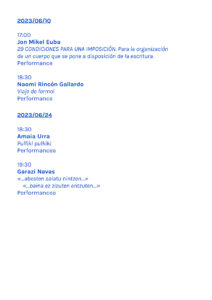
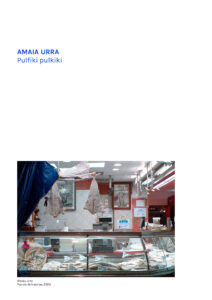
Pulkiki Pulfiki is a sung performance with a slide show of digital photographs taken at the Bretxa Market in Donostia-San Sebastian, where Amaia lives. The images mainly show the fishmongers’ counters, where signs listing the names and prices of the fish can be seen alongside the fish themselves, but also the butchers’ counters, greengrocers’ and other market stalls. In each photograph, Amaia hums a melody in which she combines the syllables of the different products. The method is reminiscent of Mikel Laboa’s Lekeitioak in which, as Oier Etxeberria —an artist and friend of Amaia’s— states, the text is blurred, becoming a sonic riddle.
At the moment, Amaia is fully focused on raising her newborn baby; going shopping is one of the things she does during the day. In the evenings, she prepares for the performance whilst her daughter sleeps.
In her book For More Than One Voice: Toward a Philosophy of Vocal Expression (2005), Adriana Cavarero writes about the voice in a lullaby: ‘In the lullaby, language returns to being pure voice, pure sound, a rhythmic pulse that does not communicate a text but rather the presence of a unique body to another. The words of the lullaby do not matter for what they mean, but for how they resonate: a vocal cradle that lulls the child into sleep through the absolute acoustic materiality of the mother’s voice’. The political body on which Cavarero’s lullabies and the Lekeitioak focus is, in this case, the body of a woman who combines artistic creation with childcare.
In the opening pages of the book Diario del afuera (Exteriors in English), which are an introduction of sorts, Annie Ernaux writes: ‘have avoided as much as possible putting myself on stage and expressing the emotion that lies at the origin of each text. On the contrary, I have tried to practice a sort of photographic writing of the real, in which the lives I happened upon would retain their opacity and their mystery. (…) But, in the end, I put much more of myself into these texts than I had intended: obsessions, memories unconsciously dictating my choice of words or the scenes I recorded. And now I am sure that one discovers more about oneself by projecting oneself into the outside world than through the introspection traditionally associated with the journal intime—which, having been around for two centuries, is not necessarily eternal’.
See: Early works, C/Aldamar (2012), Berio Pasalekua (2014), Pantalón vaquero (2012), Muleta gris (2012), Una vuelta-ta (2013–)