


Bi Dos Two is a group exhibition produced by Eremuak featuring 31 authors selected through an open call. 8 February – 8 April. Amaia Urra presents Maleza Ardiente in Cinema 3 of the Golem Cinemas. 41 min 47 sec. March 27.
Maleza ardiente (2018) is a version of the piece of the same name, Maleza ardiente (2017), which in turn is a version of Arbusto ardiente (2016–). They all belong to the series Growing Images & Talking Weeds. In this case, it is an adaptation of the performance she staged in Mexico, based on the vegetation of the Iberian Peninsula, which was presented as part of the group show Bi Dos Two, organised by eremuak at Azkuna Zentroa in Bilbao. On this occasion, Amaia decided to not use any plants, and the piece is presented in a completely darkened cinema theatre, without any visual references.
In cinema, there are different types of sound treatment, which are defined according to the way the sound relates to the image. Amaia’s voice in Maleza ardiente sounds like what is known in cinema as a close-up voice; a sound that is close, intimate, echo-free and rich in detail, and which does not carry the acoustic qualities of the space depicted in the image, but instead seems to speak directly into the viewer’s ear. A close-up voice is recorded with the mouth very close to the microphone, giving it an almost tactile quality. Amaia uses this same technique to record her voice. But unlike in cinema, the image to which this voice relates is not the one on the screen, but the one that each member of the audience imagines.
See: Early works, Growing Images & Talking Weeds (2015–), Arbusto ardiente (2016–), Maleza ardiente (2017), Arbusto ardiente (2019), Sasia sugarretan (2021–), Burning Bush (2021–), Buisson ardent (2024–)
2018
→ Bi Dos Two. Azkuna Zentroa - Alhóndiga Bilbao, Bilbao.
Bi Dos Two is a group exhibition produced by Eremuak featuring 31 authors selected through an open call. 8 February – 8 April. Amaia Urra presents Maleza Ardiente in Cinema 3 of the Golem Cinemas. 41 min 47 sec. March 27.
2018
Bi Dos Two. (2018). Eremuak.
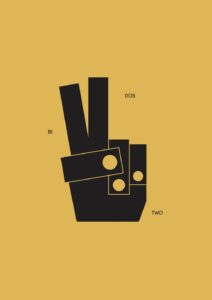
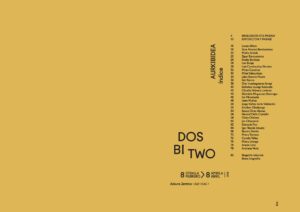
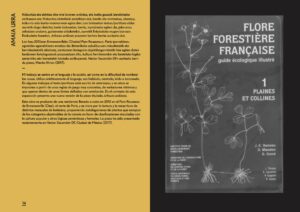
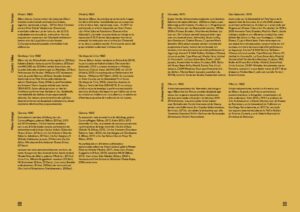
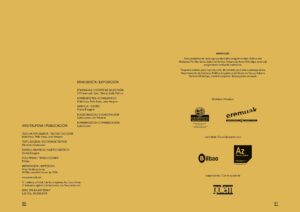
Publication for the group exhibition Bi Dos Two, organized by Eremuak at Azkuna Zentroa – Alhóndiga Bilbao. 8 February – 8 April. Among other texts, it includes an image related to Amaia Urra’s Growing Images & Talking Weeds series and a text written by the artist, in Basque and Spanish.