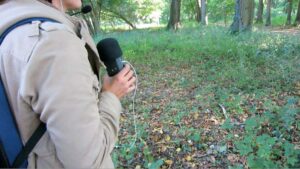
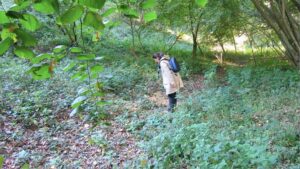
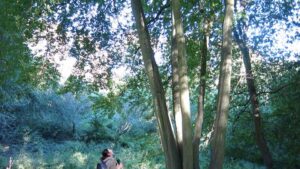
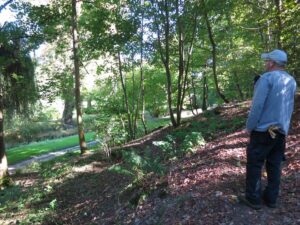
Chêne Charme Platane is the working title with which Amaia begins a new series that she will eventually call Growing Images & Talking Weeds. It originated in 2015, when Amaia had the opportunity to work with the botanists at the Jean Jacques Rousseau park, an English-style park situated in the French region of Oise, where the philosopher spent the final weeks of his life. The English-style garden, also known as a landscape garden, is a type of Romantic garden that mimics wild and idealised nature, mirroring the soul. Within the philosophy of the Romantic garden, the stroll occupies a central place for self-knowledge and is understood as the means through which the aesthetic experience is organised. In works such as Una vuelta-ta, Amaia also explores the stroll as a space for exploring the fluidity of the relationship between perception, cognition and language. In response to the invitation, Amaia once again relies on the form of the stroll and on naming what she sees, a technique she had previously used in the series Cantar las calles and in Una vuelta-ta. Unlike in these previous performances, in Chême Charme Platane, the eye that observes and describes is, this time, a trained eye. For the performance, an expert in botany names the plants, and Amaia’s focus shifts from the object —the plant— to its technical terminology.
Botanical catalogues grow as new species are discovered, catalogued, classified and named. The scientific names of plants are assigned using the binomial nomenclature system, devised by the Swedish naturalist Carl Linnaeus in the 18th century and formalised in his work Species Plantarum (1753). In the binomial system, each plant species has a unique scientific name in Latin consisting of two parts written in italics. The first part refers to the genus and is written with a capital letter. The second part is called the epithet, and this is where options come into play. The botanist who discovers or formally describes the plant will choose the specific epithet. Usually, they do so by drawing inspiration from sources such as the plant’s physical properties, its geographical origin, its uses, sometimes even a kind of secret tribute (eponyms). If the catalogue is examined closely, it is not difficult to find, for example, more or less veiled tributes to their loved ones. Linnaeus himself was known for his mischievous touch: he named beautiful or useful plants after his friends, whilst giving weeds or thorny plants the names of his enemies.
Amaia uses botany manuals often in her work. Just as with the dictionary, she employs these as a working tool in a series of consecutive pieces. These are the sources from which she extracts words, which she then sorts according to criteria not related to botany, but rather using more subjective approaches, which bring out their most expressive qualities.
See: Early works, Arbusto ardiente (2016–), Maleza ardiente (2017), Maleza ardiente (2018), Arbusto ardiente (2019), Sasia sugarretan (2021–), Burning Bush (2021–), Buisson ardent (2024–)