Double meaning is a type of wordplay that Amaia has used in her practice since the very beginning. ‘Double meaning’ is translated into Spanish as ‘doble sentido’, where ‘sentido’ means ‘sense’ as well as ‘direction’. ‘Double sense’, therefore, can also be interpreted in two ways: it can mean that a word has two different synonyms, which are not synonyms with each other, or that an action takes place in two different directions, for example, from left to right and from right to left.
In June 2000, Amaia attended a workshop led by Claudia Triozzi as part of Dos entrecuerpos. Mugatxoan hiru – A workshop by Ion Munduate and Blanca Calvo. Triozzi’s practice at that time lay somewhere between installation and performance, exploring the relationship with everyday objects in domestic settings, often through absurdity. As an individual exercise in the workshop, Amaia produced her first piece, a domestic performance recorded on video entitled Desayuno con diamantes (2000) —a wordplay with Breakfast at Tiffany’s, a film that was translated into Spanish as Breakfast with Diamonds—, which has never been presented in public. The video portrays a family breakfast of Amaia and her parents, who also take part in the piece. It is a weekday in June 2000 and the news is playing on the radio; ETA has resumed its armed struggle, José María Aznar is Prime Minister and political tensions dominate the headlines. Family dynamics run their course whilst Amaia, looking sleepy, slowly pours herself a cup of coffee, spilling it over the rim. Instead of drinking it, she lets a stream of coffee flow from her mouth, which gushes out in spurts whenever she speaks. There is a play on words in this piece, in which Amaia subverts an everyday event. To subvert is composed of the prefix ‘sub’ —low, beneath— and ‘vertere’ —to turn over, to rotate. ‘Vertere’ is also the root of the Spanish verb ‘verter —to pour a liquid, such as coffee into a cup.
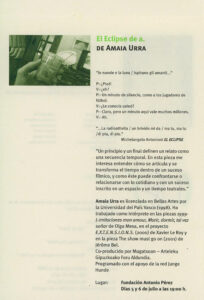
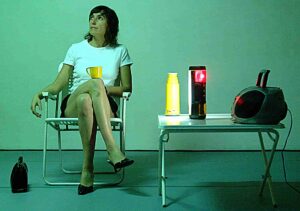
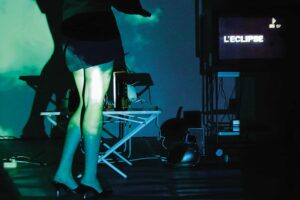
A year later, in 2001, Amaia began working on what would later become El Eclipse de A (2002), a piece she prepared and premiered at Arteleku as part of the Mugatxoan programme. El Eclipse de A is a play on words in which A stands for both Amaia and Antonioni, and the performance is structured around his film L’Eclisse (1962). According to specialised reviews, Antonioni also makes use of a play on words, in his case between ‘eclipse’ and ‘ellipsis’. Amaia uses rewind in combination with ellipsis to, through a carefully staged performance, ‘re-edit’ the film, both in the sense of reworking the plot and in that of travelling the opposite way, as if it were a river, against the current. The image and sound are brought onto the stage via two video players connected to a monitor and a projector respectively, and a cassette player, all of which are controlled live by Amaia using remote controls that she takes in and out of a handbag similar to the one worn by Monica Vitti in the film.
No Goal is a video project created to be screened in the café at the Recyclart production centre in Brussels. In English, goal means an objective or purpose, but also a football goal. In the preparatory video that Amaia found on one of her hard drives, we see a group of children playing five-a-side football in an outdoor area near Recyclart. The game seems chaotic at first —partly fuelled by Amaia’s presence with her camera— but it gradually becomes more organised as the video progresses. The children do not count the goals, and there is no scoreboard. Amaia follows the movement of the ball with the camera; she, too, keeps it in motion. In 2015, as part of the Proklama No. 5 programme at Artium Museoa, José Antonio Sánchez gave a lecture on contemporary performance practices. During that lecture, he quoted Rafael Sánchez Ferlosio, who, in God & Gun, proposes a classification of games based on the ideas of Johan Huizinga, according to two dimensions: agonistic/anagonistic games —competitive or non-competitive— and nomic/anomic games —with rules or without rules. According to Sánchez Ferlosio, there is a type of game that is both anagonistic and anomic. A particular case of this type of game are what he calls ‘sliding’ games —games with no rules or meaning beyond pure present-moment joy– typical of slippery surfaces such as snow-covered slopes. As one slides down a slope, the kinetic pleasure, in itself, exceeds the effort required to make the most of the terrain and the context, ‘as if in a present moment that kept spinning round and round, or, in a word, in a state of still’. Football, for both Huizinga and Sánchez Ferlosio, is a clear example of an agonistic game. But if some of its rules are suspended —such as not counting goals— then it is the pure movement of the ball, captured on video, that matters.
The Neverstarting Story is a collaborative project by Cuqui Jerez, María Jerez, Cris Blanco and Amaia Urra that took place between 2006 and 2009. Like many of the works grouped under the term ‘new scene’, which emerged in Central Europe in the 1990s and gained a significant presence in Spain in the 2000s, The Neverstarting Story is characterised by a critical examination of staging, extending the concept of choreography to the processes of research, creation, presentation, production and dissemination, as well as to the relationship established between the stage and the audience, its involvement and perceptual experience. The premise behind The Neverstarting Story was to create a context for collaborative work that was not based on the authorship of ideas, but on the creation of a shared lexicon. The work, which took place in the studio, was presented to the public in various ways across the different residency spaces and festivals where it was staged. As a result, four pieces were created in which, whilst each was credited to a specific author, all four were involved, as well as a short film co-authored by the group, entitled Cinthy Tuloh.
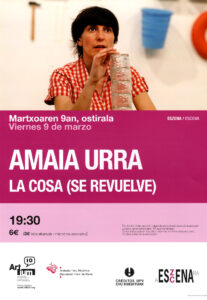
La cosa (or The Thing), by Amaia Urra, took on different forms in its performances. In Bogotá, it was presented as a stage piece comprising four monologues delivered with a touch of humour, in which the instructions that all the performers were following could be guessed. In the introduction, Amaia presented ‘the thing’ as that for which we cannot find —or perhaps do not even seek— a more specific definition. She also expressed her interest in the things we do more or less unintentionally when we ought to be doing something else. Amaia uses the English term ‘fiddling’ to refer to the material she was working on whilst preparing La cosa. In Spanish, we use words that could be translated into English as toying, tinkering or rollicking to describe what we do with our hands when our minds are elsewhere —for example, whilst we are doing or attending to other things. These are more or less automatic or involuntary actions, without any pre-determined meaning, which often take place in the background. How do these gestures operate, transform and organise? This is perhaps what all the representations in La cosa have in common: an approach to the indeterminate, the open and the subtle, which embraces small, shifting and meaningless forms.
At La Villette, La cosa (or The Thing) evolved into a video installation made up of three single-channel works, created from video recordings of traffic scenes: airports, roundabouts and road signs alongside motorways. Amaia played with these during the editing process, mixing the images with sounds in the style of a video game. In the book Rules of Play: Game Design Fundamentals, Katie Salen and Eric Zimmerman draw on Huizinga’s concept of the ‘temporary world’ and make it the cornerstone for explaining how video game players immerse themselves in virtual universes. Huizinga’s ‘temporal world’ is a refuge; it withdraws from everyday life to create its own micro-universe with its own perfect rules, and when it ends, the player returns to his or her reality unchanged.
These same recordings, stripped of their graphic elements and remixed into a single mono track, would later become Time Wasters. Divert and distract share an etymological root in the Latin divertere, composed of the prefix dis / di —meaning separation, or towards two different sides— and vertere —to turn, to turn round or to turn over. In Old Spanish, it retained its original meaning of ‘to divert or separate’, but over time, the metaphorical sense of ‘diverting one’s mind or attention from work, routine and worries’ came to almost completely replace the word’s original meaning. Today, in Spanish, it means exclusively ‘to provide recreation, to entertain or to bring joy’. It entered English in the 16th century via French. As in Spanish, it retained its original meaning, but over time, whilst the verb kept it, the noun diversion eventually split into two meanings and is now a polysemous term referring both to a change or separation of direction and to entertainment. Interestingly, it has also become a partial false friend of distraction; let’s say they were friends who at some point parted ways and who, in this piece by Amaia, meet again.
Time Wasters plays with the non-places defined by Marc Augé: places of transit, anonymous spaces where interaction is mediated by posters, text and signage. During the years that Amaia toured extensively, mainly with artists Xavier Le Roy and Jérôme Bel, she spent many hours waiting in and around airports, which she captured on video with a handycam, abstracting, displacing and separating the image from its specific context through a playful use of editing and camera movements.
In La Cosa, Amaia Urra combines video, voice, music and a variety of objects to create a solo performance. Just as she stated in that other La Cosa (or The Thing) from 2008, the word thing is a semantic void, an abstraction of language that only acquires meaning the moment a speaker applies it to a specific reality. Its mathematical equivalent would be the numbers. Amaia lists objects, words, letters and sounds, using them to link together a series of actions that connect them. Amaia avoids narrative. La Cosa deals with indeterminacy itself; it is an exercise in deviation, in escape, reminiscent of the film The Way Things Go (1987) by Peter Fischli and David Weiss. In both works, what is crucial is to keep the movement alive, and with it the power of a during without an end. Where to begin? With A, in alphabetical order. And what is A? Whatever the dictionary says, which in its definition links it to other words. The dictionary is an important creative resource for Amaia. So too is video, a medium through which she connects with other spaces. In the images, as well as in the postcards that Amaia is supposed to have sent to herself and which she reads on stage, here —and therefore there— can refer both to the scene and to her studio at Arteleku.
2002
→ El Eclipse de A. Estreno en Mugatxoan 2002, Arteleku, San Sebastián.
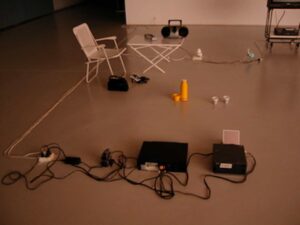
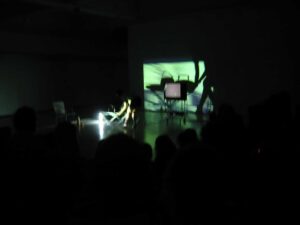
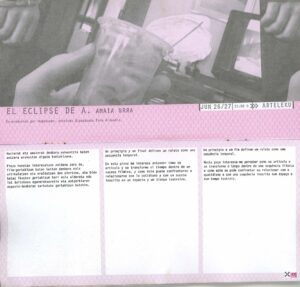
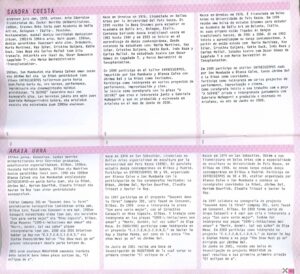
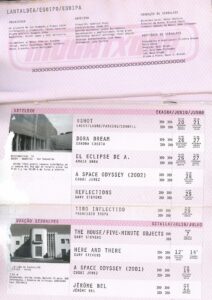
El Eclipse de A. is a performance by Amaia Urra that explores and confronts real time, cinematic time, and stage time. Seated on stage watching a TV screen, Amaia manipulates fragments of the film L’Eclisse by Michelangelo Antonioni through rewinding, repetition, back-tracking, and fast-forwarding. 26 and 27 June.
Video recording: Cuqui Jerez.
Concept and performance: Amaia Urra.
Artistic assistant: Blanca Calvo.
B&W film: L’Eclisse (The Eclipse) by Michelangelo Antonioni.
Music: Original soundtrack from L’Eclisse (Fusco and Mina, Eclisse Twist).
Video: Amaia Urra.
Coproduced by: Mugatxoan – Arteleku, Gipuzkoako Foru Aldundia.
Supported by: STUK (Leuven).
2002
→ El Eclipse de A. Festival Situaciones, Cuenca.
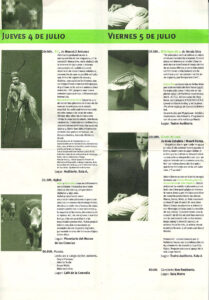
5 July.
2003
→ El Eclipse de A. Klapstuk#11, STUK, Lovaina.
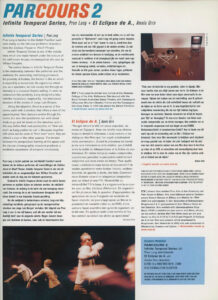
14 and 15 October.
Photographs: Liesbeth Bernaerts.
2004
LAURENR, Denis (ene.-feb. 2004). «Time (Re)Presentation». Gus magazine, 70-73.
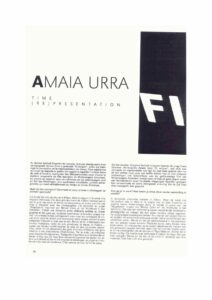
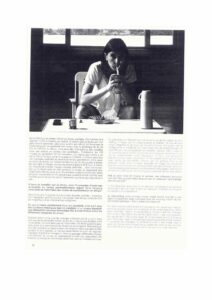
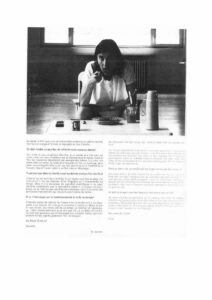
Interview with Amaia Urra, in French and Dutch, regarding El Eclipse de A. and her treatment of time within the piece.
2009
→ El Eclipse de A. Mugatxoan 2009, La Laboral Escena, Gijón, y Fundação de Serralves, Oporto.
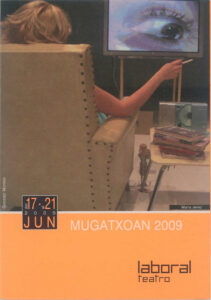
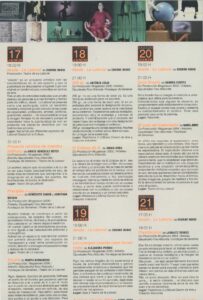
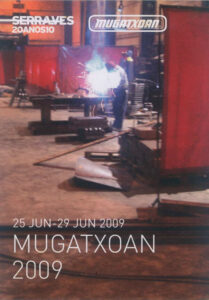
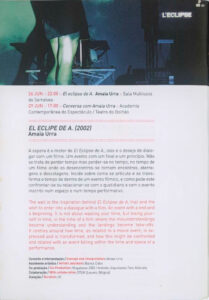
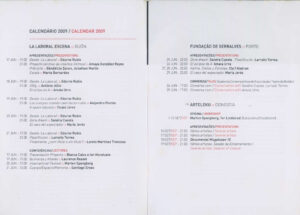
19 June at La Laboral and 27-28 June at Fundação de Serralves.
2012
DE NAVERÁN, Isabel (2012). «Desviando la atención. De la representación del cuerpo al cuerpo vector en la nueva danza». Desacuerdos 7, 174-184.
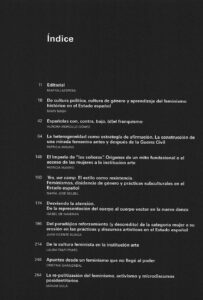
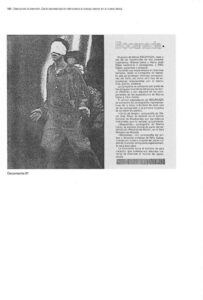
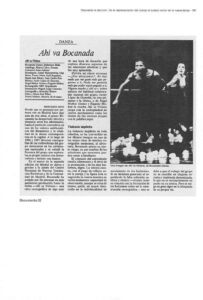
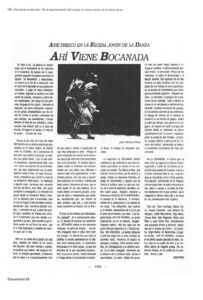
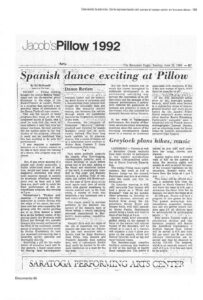
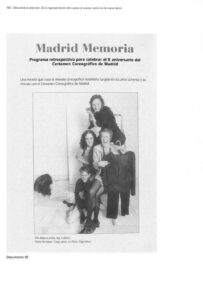
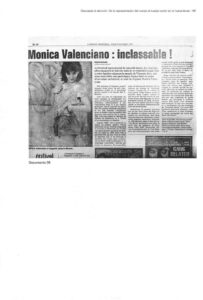
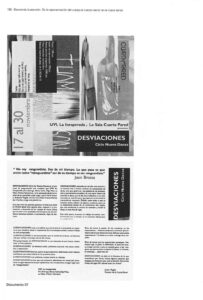
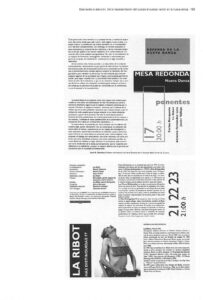
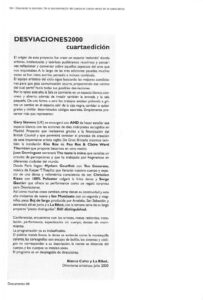
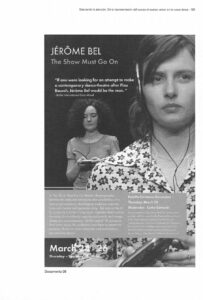
This article traces a genealogy of the work carried out by women in the field of dance over the last 25 years. Amaia Urra is mentioned in relation to her participation in Jérôme Bel’s The show must go on and, more extensively, regarding her piece El Eclipse de A. (2001). In addition, Isabel de Naverán cites El Eclipse de A., alongside La cosa (2010) —and other works by artists Cristina Blanco, Cuqui Jerez, and María Jerez—, as a reflection of the critical questioning of the stage apparatus that defined the 2000s.
2006
→ The Neverstarting Story en colaboración con Cristina Blanco, María Jerez y Cuqui Jerez. Residencia de investigación en La Mekanica, Barcelona.
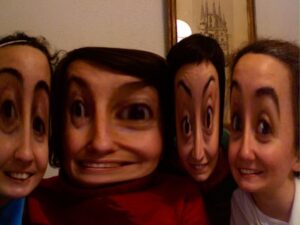
The project is created in response to a proposal by the Aula de Danza of the University of Alcalá de Henares to Cuqui Jerez to undertake a research residency at La Mekanica, Barcelona, as part of an exchange programme between both structures. Cuqui, María, and Amaia, along with Cristina Blanco, began working together on various ideas, initiating a collaboration that led to the creation of The Neverstarting Story. April.
The Neverstarting Story is defined as a research project in search for a way to collaborate and work together without reaching a consensus. Its starting point is common material that the four artists decided to develop based on the principle of non-ownership of ideas. The project branched into four different directions: The Set Up, directed by Cristina Blanco; The Rehearsal, directed by Cuqui Jerez; The Thing, directed by Amaia Urra; and The Movie, directed by María Jerez—in addition to a collective collaboratively made short film, Cinthy Tuloh.
2008
→ The Neverstarting Story. 100 dessus dessous, Parc de La Villette, París.
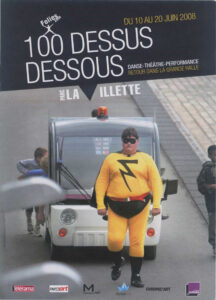
Presentation of the four pieces that make up The Neverstarting Story. The piece directed by Amaia Urra, The Thing, takes on a unique form in each of its presentations. At La Villette, it is a video installation composed of three videos in which, as if playing a video game, Amaia plays with the camera, the landscape and the physical limits of the screen: Border Line (2 min 59 sec), Frame Track, Slide Cars (1 min). 20 June.
2009
→ Jeux-vidéo-jeux. Nuits Vagues, 3 bis f − Centre d'arts contemporains, Aix en Provence.
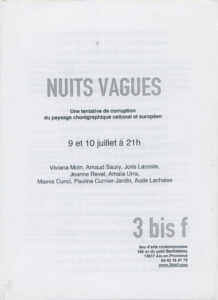
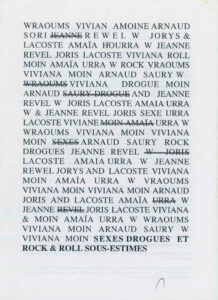
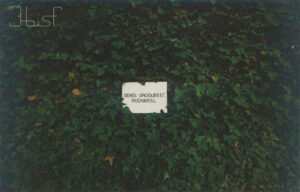
Video installation that revisits and expands on the installation of The Thing presented at La Villette (2008). The work is made of videos created by Amaia in the style of a video game, in which the artist plays with the camera, the landscape, and the physical limits of the screen. 9-10 July.
2010
→ Time-Wasters. Festival In-Presentable, La Casa Encendida, Madrid.
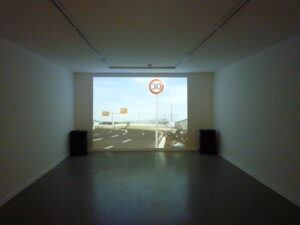
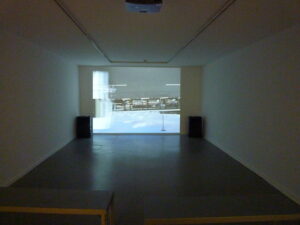
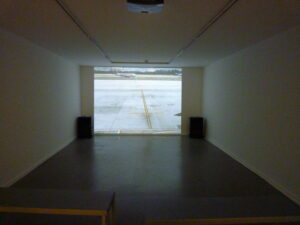
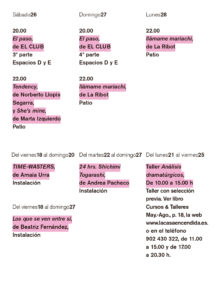
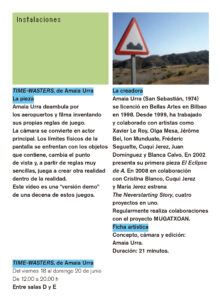
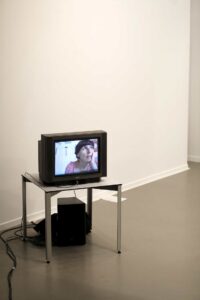
Video installation that revisits the installation of The Thing presented at La Villette (2008) and its subsequent adaptation Jeux-vidéo-jeux, shown at 3 bis f – Centre d’arts contemporains, Aix en Provence (2009). These pieces are formed by videos created by Amaia Urra in the style of a video game, in which the artist plays with the camera, the landscape, and the physical limits of the screen. Time-Wasters reedits and gathers the videos into a single piece. 18-20 June.
Concept, camera, and editing: Amaia Urra. 21 min.
2011
PÉREZ ROYO, Victoria (dic. 2011). «Cómo hacer cosas nuevas con movimientos». Telondefondo. Revista de teoría y crítica teatral, año VII, (14), 195-209.
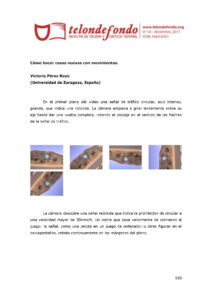
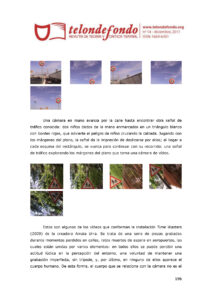
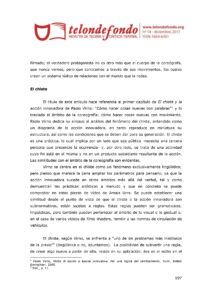
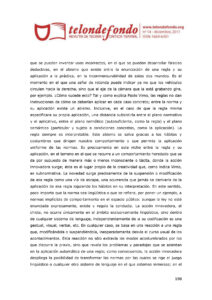
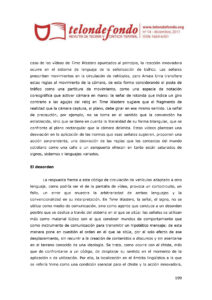
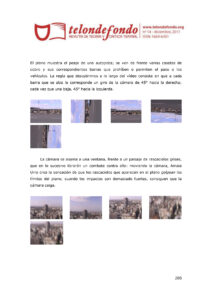
Article that analyses in depth the series of videos that form the installation Time-Wasters. Based on the theories on innovative action and on the secondary production of everyday objects, by Paolo Virno and Michel de Certeau respectively, the text examines how Amaia Urra diverts, displaces, and subverts everyday codes—such as traffic signs—to generate a subjective and playful re-appropriation of the environment, based on the relationship between the body, the camera, and the surrounding context.
2010
→ La cosa. Estreno en el festival In-Presentable, La Casa Encendida, Madrid.
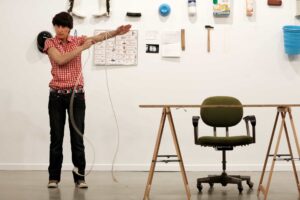
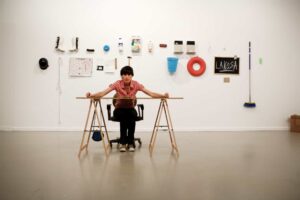
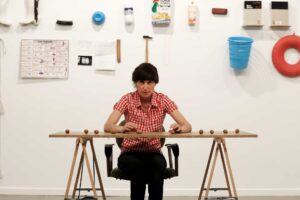
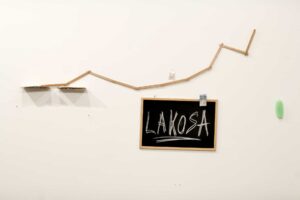
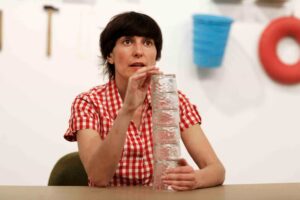
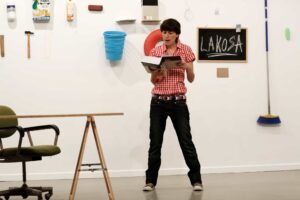
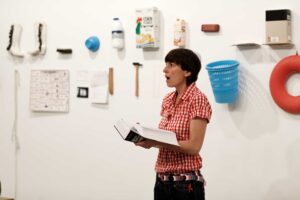
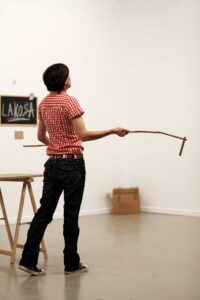
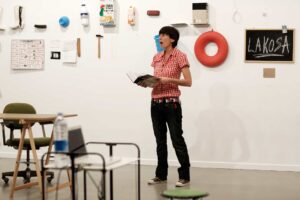
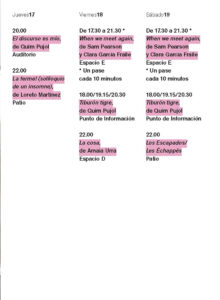
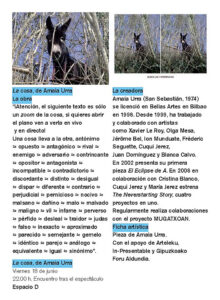
Stage piece that proposes fleeing from straight lines and lingering on the path and the detours: to start by doing one thing, only to end up doing another. 18 June.
Photographs: Enrique Escorza.
A performance by Amaia Urra.
Funded by the Basque Government’s Department of Culture (Eusko Jaurlaritza).
With the support of Arteleku, In-Presentable and the Provincial Council of Gipuzkoa (Gipuzkoako Foru Aldundia).
2010
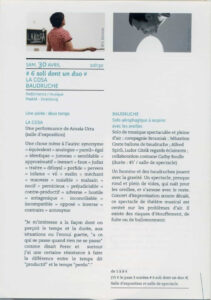
→ La cosa. Festival de teatro y danza contemporánea de Bilbao BAD, Sala Rekalde, Bilbao.
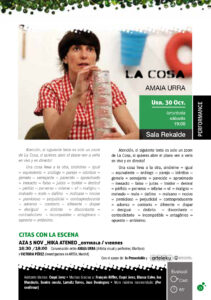
30 October.
Video: Bilbao BAD.
2011
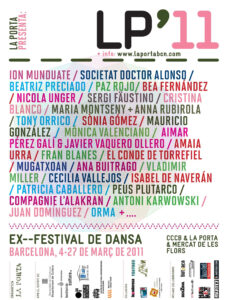
→ La cosa. LP'11, ex-festival de danza, La Porta, Barcelona.